Currently Empty: £ 0.00

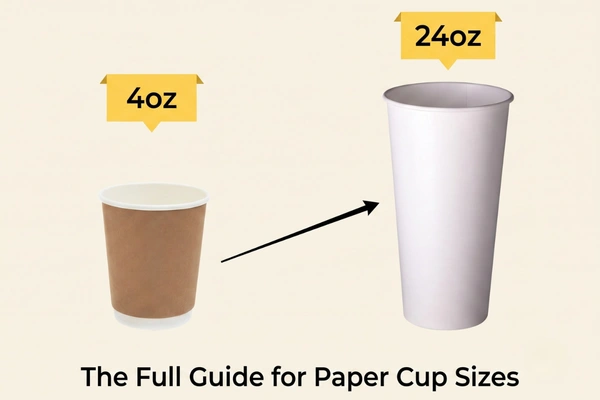
A paper cup’s size is three linked measurements, not one: the labelled capacity printed on the wall, the usable fill volume you actually pour, and the physical dimensions that decide which lid, sleeve and tray fit. Reading all three together is what lets you match a cup to your menu and order the right stock the first time.
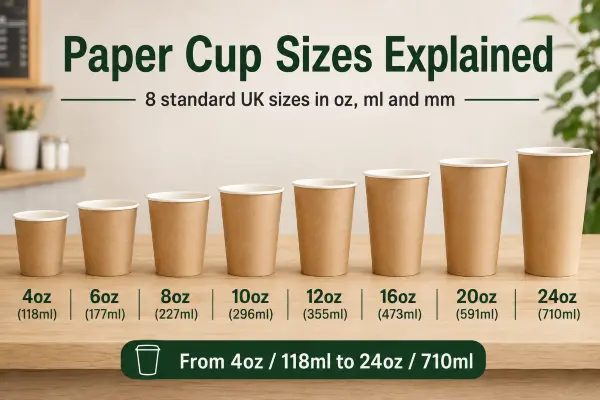
UK paper cups follow eight standard capacities, from 4 oz (118 ml) espresso cups up to 24 oz (710 ml) cold cups. This guide gives the full oz, ml and mm chart, answers how many millilitres a small cup holds, shows which size suits which drink, explains how dimensions govern lids, sets out how much a cup weighs, then walks through ordering.
What Is a Paper Cup Size? Capacity, Fill and Dimensions
A paper cup’s size is its labelled capacity, the near-brim volume the cup holds, which sits above the usable fill volume and stays separate from its physical dimensions. The label states volume in fluid ounces; the body has its own height, top diameter and bottom diameter in millimetres.
Two cups marked 12 oz can still differ in shape. One might stand taller with a narrow rim, another shorter and wider, because manufacturers reach the same 355 ml volume with different proportions. Capacity tells you how much liquid the cup takes; dimensions tell you how it behaves on the line, which lid clicks on and how it stacks.
Volume follows the metric relationship of 1,000 ml to 1 litre, while the oz on the label is a US fluid ounce of about 29.6 ml. Holding both units in view keeps ordering accurate across UK and international suppliers.
Labelled Capacity vs Usable Fill Volume
Labelled capacity is the volume at the brim; usable fill is what you pour in service. Real pours leave 10% to 20% headroom for foam, ice and lid clearance, so the working volume reads lower than the label.
An 8 oz / 237 ml cup pours around 190 ml to 210 ml of drink once you allow that gap. The same rule scales up the range, which is why a barista fills to a line rather than the rim.
| Size | Brim-full | Practical fill |
| 8 oz | 237 ml | 190 ml to 210 ml |
| 12 oz | 355 ml | 290 ml to 320 ml |
| 16 oz | 473 ml | 390 ml to 430 ml |
How Size Is Measured: oz, ml and mm
Three units describe a cup, each ruling a different property. Fluid ounces label the capacity and follow the US cup-industry standard; millilitres give the metric volume UK buyers work in; millimetres and inches record the physical dimensions, meaning height, top diameter and bottom diameter.
Converting between them keeps specifications aligned when a supplier quotes one unit and your lids are sized in another.
| Convert | Factor | Example |
| oz to ml | 1 US fl oz ≈ 29.6 ml | 12 oz ≈ 355 ml |
| inch to mm | 1 in = 25.4 mm | 3.5 in = 88.9 mm |
| ml to litre | 1,000 ml = 1 litre | 500 ml = 0.5 litre |
Paper Cup Size Chart: 8 Standard Sizes in oz, ml and mm
The chart below sets out the eight standard EcoLife paper cup sizes with capacity, rim and base diameter, height and typical use, so you can match a size to a drink at a glance.
| Size | Capacity | Top Ø | Base Ø | Height | Typical use |
| 4 oz | 118 ml | 62 mm / 2.44 in | 42 mm / 1.65 in | 60 mm / 2.36 in | Espresso, tasting samples |
| 6 oz | 177 ml | 70 mm / 2.76 in | 50 mm / 1.97 in | 78 mm / 3.07 in | Flat white, cortado |
| 8 oz | 237 ml | 80 mm / 3.15 in | 55 mm / 2.17 in | 92 mm / 3.62 in | Small latte, tea |
| 10 oz | 296 ml | 90 mm / 3.54 in | 60 mm / 2.36 in | 98 mm / 3.86 in | Cappuccino, filter |
| 12 oz | 355 ml | 90 mm / 3.54 in | 60 mm / 2.36 in | 110 mm / 4.33 in | Latte, flat white |
| 16 oz | 473 ml | 90 mm / 3.54 in | 60 mm / 2.36 in | 135 mm / 5.31 in | Iced coffee, large filter |
| 20 oz | 591 ml | 90 mm / 3.54 in | 60 mm / 2.36 in | 150 mm / 5.91 in | Smoothie, milkshake |
| 24 oz | 710 ml | 90 mm / 3.54 in | 60 mm / 2.36 in | 165 mm / 6.50 in | Large cold drinks, bubble tea |
The 10 oz and 20 oz hot cups share the 90 mm rim used by 12 oz and 16 oz, so one lid family covers four sizes. Finished dimensions carry a manufacturing tolerance of about 1 mm to 2 mm, normal for pressed board and rarely enough to affect lid fit.
How Many ml Is a Small Paper Cup?
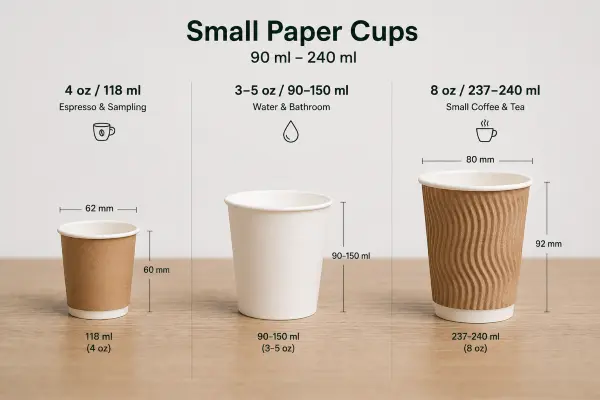
A small paper cup holds roughly 90 ml to 240 ml, which covers 3 oz to 8 oz depending on the job it does. Small cups split into three roles: short coffee shots, non-coffee water and washroom cups, and the small takeaway coffee. The dedicated guide to How Many ml in a Small Paper Cup breaks the figures down further.
4 oz Espresso and Sampling Cups (118 ml)
The 4 oz cup is the smallest in common use at 118 ml, with a 62 mm rim and a 60 mm height. It suits a single espresso, spirit and tasting samples, sauces and portion dosing. Its narrow base keeps a short pour looking full, so a small serving still reads as generous value to the customer.
3 to 5 oz Water Cooler and Bathroom Cups (90 to 150 ml)
The non-coffee small cup runs 90 ml to 150 ml as a cone or flat cup for water coolers, dispensers and washrooms. These use a thinner wall than coffee cups and have no lid seat, since they serve a single quick drink at the tap rather than a takeaway. Cost per unit stays low because the board is light and the shape simple.
8 oz Small Coffee and Tea Cups (237 to 240 ml)
The 8 oz cup is the default small takeaway coffee at 237 ml to 240 ml, with an 80 mm rim and a 92 mm height. It pours a small latte, cortado, tea or hot chocolate with room for foam. Its 80 mm rim sits in its own lid family, apart from the 90 mm lids used across the medium and large range, which matters when you standardise stock.
Medium and Large Sizes: 10 oz to 24 oz Compared
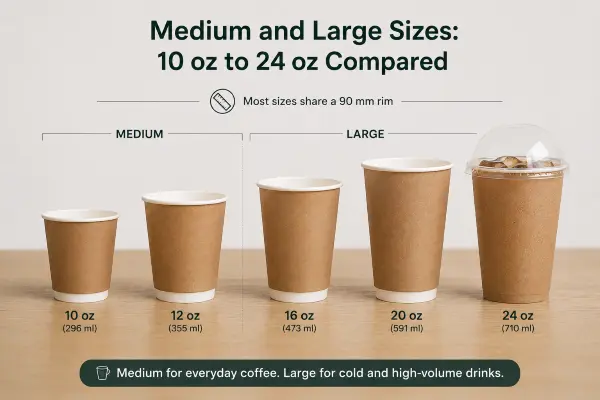
Medium cups carry the everyday coffee menu, while large cups take cold and blended drinks that need volume for ice. The step from 10 oz to 24 oz roughly doubles capacity, yet most of these sizes share the same 90 mm rim, so scaling up rarely means a new lid.
Medium Cups: 10 oz and 12 oz (296 to 355 ml)
The 10 oz cup holds 296 ml in a short, wide body on a 90 mm rim, and it often takes the 12 oz lid. The 12 oz cup holds 355 ml at 110 mm tall and is the UK café default for latte, cappuccino and flat white. Both share the 90 mm lid, so a site running 10 oz and 12 oz together needs only one lid line.
Large Cups: 16 oz to 24 oz (473 to 710 ml)
Large cups cover 16 oz at 473 ml, 20 oz at 591 ml and 24 oz at 710 ml. They pour iced coffee, smoothies, milkshakes and large filter, where the extra height gives room for ice and a domed lid.
Hot and cold 20 oz cups differ: the cold version runs taller with a wider rim for a straw-friendly dome, while the hot version keeps the 90 mm coffee rim. Taller cups need a wider base for stability, which is why a 24 oz cup sits on a broader foot than its height alone would suggest.
- 16 oz: 473 ml, 90 mm rim, 135 mm tall.
- 20 oz: 591 ml, 90 mm rim, 150 mm tall.
- 24 oz: 710 ml, 90 mm rim, 165 mm tall.
Which Cup Size Suits Which Drink?
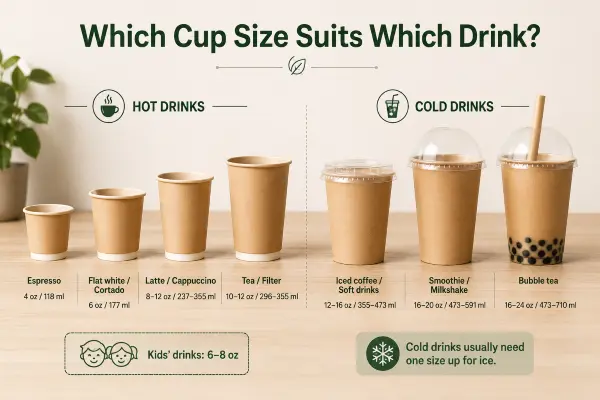
Matching size to drink follows the volume of the serve plus room for milk, foam or ice. The ladder below pairs each drink with a recommended capacity, and the Which Cup Size for Which Drink guide covers edge cases like layered iced drinks.
| Drink | Size | Capacity | Why |
| Espresso | 4 oz | ||
| Flat white, cortado | 6 oz | ||
| Latte, cappuccino | 8 to 12 oz | ||
| Filter, tea | 10 to 12 oz | ||
| Iced coffee, soft drinks | 12 to 16 oz | ||
| Smoothie, milkshake | 16 to 20 oz | ||
| Bubble tea | 16 to 24 oz | ||
| Kids’ drinks | 6 to 8 oz |
Cold drinks need one size up from their hot equivalent to hold ice, so a customer ordering a 12 oz hot coffee usually wants a 16 oz iced version. Offering a three-size ladder of small, medium and large keeps the menu simple while covering most orders.
How Do Cup Dimensions Affect Lids, Sleeves and Trays?
Fit is governed by dimensions, not capacity: a lid matches the top diameter of the cup, so two cups of different volume share one lid when their rims agree. This is why the 90 mm family spans 10, 12, 16 and 20 oz, and why choosing sizes with an eye on rim diameter cuts the number of lid, sleeve and tray lines you hold.
Why Top Diameter Matters More Than Capacity for Lids
A lid seals on the rim, so the top diameter sets compatibility while height and volume do not. Two cups with an 80 mm rim take the same lid even if one holds 8 oz and the other more; the same holds for the 90 mm rim across the medium and large range.
- 80 mm rim family: 8 oz.
- 90 mm rim family: 10, 12, 16 and 20 oz (typical).
Matching 80 mm and 90 mm Lids to Your Cups
Mapping cups to rims keeps your lid, sleeve and carrier stock to a short list. Sleeves and trays follow the same rim logic as lids, so a mixed estate should standardise on two rim sizes rather than one per capacity. The Cup Lid Compatibility Guide sets out every pairing.
| Rim | Fits cups | Lid and sleeve |
| 80 mm | 8 oz | 80 mm lids, small sleeve |
| 90 mm | 10, 12, 16, 20 oz | 90 mm lids, standard sleeve |
How Much Does a Paper Cup Weigh?
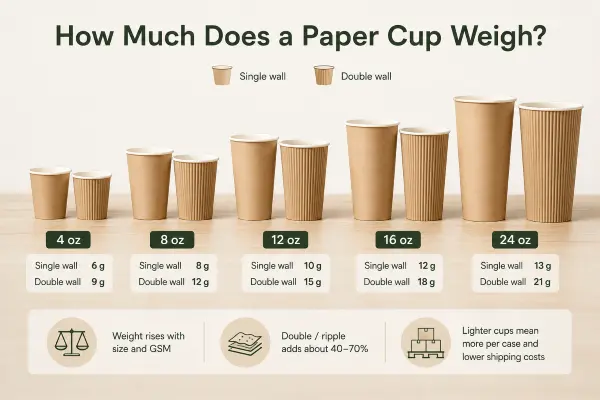
A single-wall paper cup weighs roughly 6 g to 13 g, rising with size and board weight, while double-wall and ripple cups add about 40% to 70% for the extra layer. Weight tracks GSM, the grammage of the paperboard, which sets both how heavy a cup is and how rigid it feels in the hand.
Board grammage carries through to logistics: heavier cups raise pallet weight and shipping cost, and they change how many units fit a case. The How Much Does a Paper Cup Weigh guide and the Measure GSM for Paper Cup explainer show how to read grammage on a spec sheet.
| Size | Single-wall | Double-wall |
| 4 oz | 6 g | 9 g |
| 8 oz | 8 g | 12 g |
| 12 oz | 10 g | 15 g |
| 16 oz | 12 g | 18 g |
| 24 oz | 13 g | 21 g |
How Does Wall Construction Change the Size You Need?
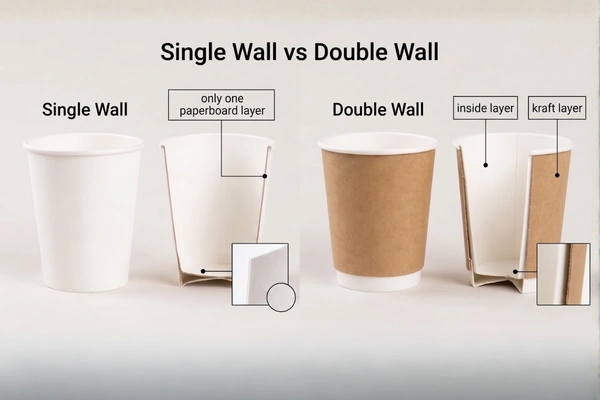
Wall construction changes the outside of a cup without changing its internal capacity: single, double and ripple cups all hold the same volume for a given oz size, but thicker walls add about 2 mm to 4 mm to the outer diameter. That extra thickness shifts sleeve and, occasionally, lid fit, and it changes how the cup feels in the hand.
Double-wall and ripple cups trap air between layers to insulate hot drinks, so a separate sleeve becomes optional on those builds. The Single Wall vs Double Wall and Ripple Wall vs Double Wall comparisons weigh cost against insulation.
| Construction | Wall | Outer Ø effect | Best for |
| Single wall | One layer | Baseline | Cold drinks, short holds, printed branding |
| Double wall | Two layers | +2 to 3 mm | Hot drinks without a sleeve |
| Ripple | Fluted outer | +3 to 4 mm | Hot drinks, textured grip |
For a fuller comparison of insulation, holds and hot-drink performance, the Paper Cups for Hot Drinks: Buying Guide pillar carries the detail.
How Do You Choose and Order the Right Cup Sizes?
Choosing sizes comes down to three moves: match capacities to your top three drinks, standardise on two rim diameters to keep lids simple, and size cold cups up for ice. Getting these right before you order avoids overstocking sizes that rarely sell.
Matching Sizes to Your Menu and Order Volume
A short method turns a menu into an order:
- List your drinks, from espresso to iced and blended.
- Assign each drink a capacity from the size chart.
- Cluster the result into two or three sizes to limit SKUs.
- Standardise on 80 mm and 90 mm rims across those sizes.
- Set order quantity to your typical weekly covers, then add a small buffer.
EcoLife’s low minimum order quantity suits small and mid-size operators, so you can hold quality stock without committing to volumes you will not use.
Testing Sizes With a Sample Pack First
Proving fit before a bulk run removes the guesswork: order a small sample pack, then check cup feel, lid seat and the fill line against your actual drinks. Trialling one or two sizes first de-risks the choice and confirms the rim standard works across your machines.
Paper Cup Size Frequently Questions And Answered
Four questions come up repeatedly once the sizing basics are clear.
Is 1 Cup the Same as a Paper Cup in the UK?
No. A ‘1 cup’ measure in UK cooking is a recipe unit of 250 ml in metric or 284 ml in old imperial, used for portioning ingredients, not a physical paper cup. A paper cup’s ‘cup’ is instead a labelled fluid-ounce capacity, so an 8 oz cup holds 237 ml regardless of the kitchen measure.
| Cup measure | Volume |
| UK metric cup | 250 ml |
| UK imperial cup | 284 ml |
| US cup | 237 ml |
Are Paper Cup Sizes the Same in the UK, EU and US?
The oz labels match, because paper cups are made to US fluid-ounce sizing worldwide, so an 8 oz cup is 237 ml in London, Berlin or New York. The catch is the fluid ounce itself: a UK imperial fluid ounce is 28.4 ml against the US 29.6 ml, so cup oz should not be read as UK fluid ounces. EU suppliers list the identical cups in millilitres, which sidesteps the ambiguity.
What Is the Most Common Paper Cup Size?
The 12 oz cup (355 ml) is the most-used takeaway size in the UK, with 8 oz second for small coffee and tea. The 12 oz sits at the balance point of drink volume, hand-feel and lid availability, which is why cafés default to it for latte, cappuccino and flat white. Stocking 8 oz and 12 oz together covers most hot-coffee orders on two rim sizes.
Do Bigger Cups Cost More and Add to the Plastic Tax?
Larger cups do cost more, both to buy and to ship: they use more board, weigh more and take more space per case. The UK Plastic Packaging Tax applies to the plastic components of packaging, such as the lining and lids, that contain less than 30% recycled content, charged at £228.82 per tonne from 1 April 2026 and paid by the manufacturer or importer rather than the café (GOV.UK). Right-sizing cups to the drink controls board use, shipping and plastic-component weight together, so the UK Plastic Packaging Tax Explained guide is worth reading before a large order.